
Where Did the Climate Seed Money Go?
The $2 million "figure it out" seed round for climate tech and hard-tech founders is dead.
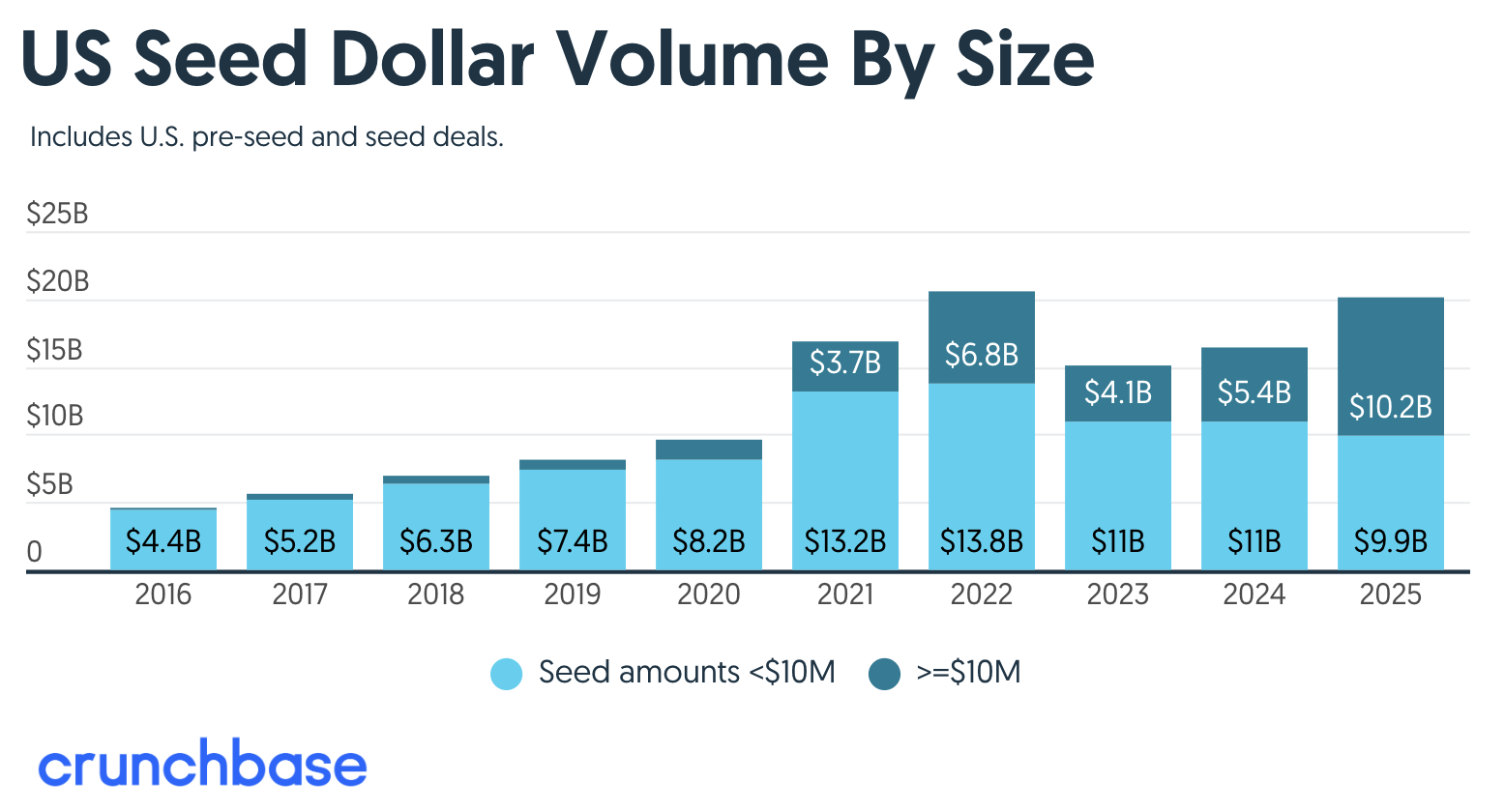
More than half of all seed dollars are now locked up in deals of $10 million or more. But for climate tech specifically, the math is even more brutal. According to recent market data, the venture capital share of total climate funding has plummeted from 20% down to less than 8%.
Where did the money go? It moved downstream. 75% of all new climate capital is now locked up in massive infrastructure mega-funds. The capital stack has completely inverted. The money is still there, but it is sitting in funds that take zero science risk and won't touch you until you have a repeatable, commercial-scale project.
VCs are trapped in $5.8 trillion worth of aging, illiquid unicorns and are managing their own tapped-out runways. They can no longer risk funding early-stage bets that don't have a crystal clear path to a Series A markup. Investors simply do not have the liquidity to be patient anymore.
If you are still carrying core science risk into a pitch today, or if you don't understand how your capital stack needs to evolve, you are going to hit a wall.
I help founders navigate this fundraising trap. Here is how you adjust your capital strategy to survive this new reality:
👉 Prove the math before you build the machine. Prove your unit economics work on a spreadsheet. If your technology can't beat the incumbent on paper, no infrastructure fund is going to pay you to deploy it in the real world. Run the math, figure out exactly which engineering variable actually moves the needle on cost, and point your R&D at that one thing.
👉 Stop using equity to buy pipes and steel. If you pitch a Seed round where the primary use of proceeds is buying industrial equipment or basic lab space, sophisticated investors will pass. Venture capital isn't for buying hard assets. If you are building First-of-a-Kind technology and cannot use contract manufacturers, you must isolate the exact engineering hurdle that proves the science works, and build only that.
👉 Bridge the gap with patient capital. If the science isn't de-risked, venture capital is not going to bail you out. You have to bridge the 'First Valley' by hunting down non-dilutive federal grants, subsidized incubator space, and angel syndicates willing to fund early science risk. Be realistic about the timeline: while some grants move fast, many DOE cycles stretch for months. Build a runway model that survives that uncertainty.
👉 Tell the right story. When you finally do pitch VCs for equity, stop pitching the science experiment. If you have de-risked the core tech, but you are still pitching R&D milestones, you are killing your own deal. Show investors exactly how this seed capital guarantees the specific metrics required to raise a Series A.
Recognize the market you are in. Build the business case. Take charge of your startup’s destiny.
Take Charge of Your Startup's Destiny
You don't have to navigate your hardest inflection points alone. I partner with founders to bridge the gap between vision and execution.